
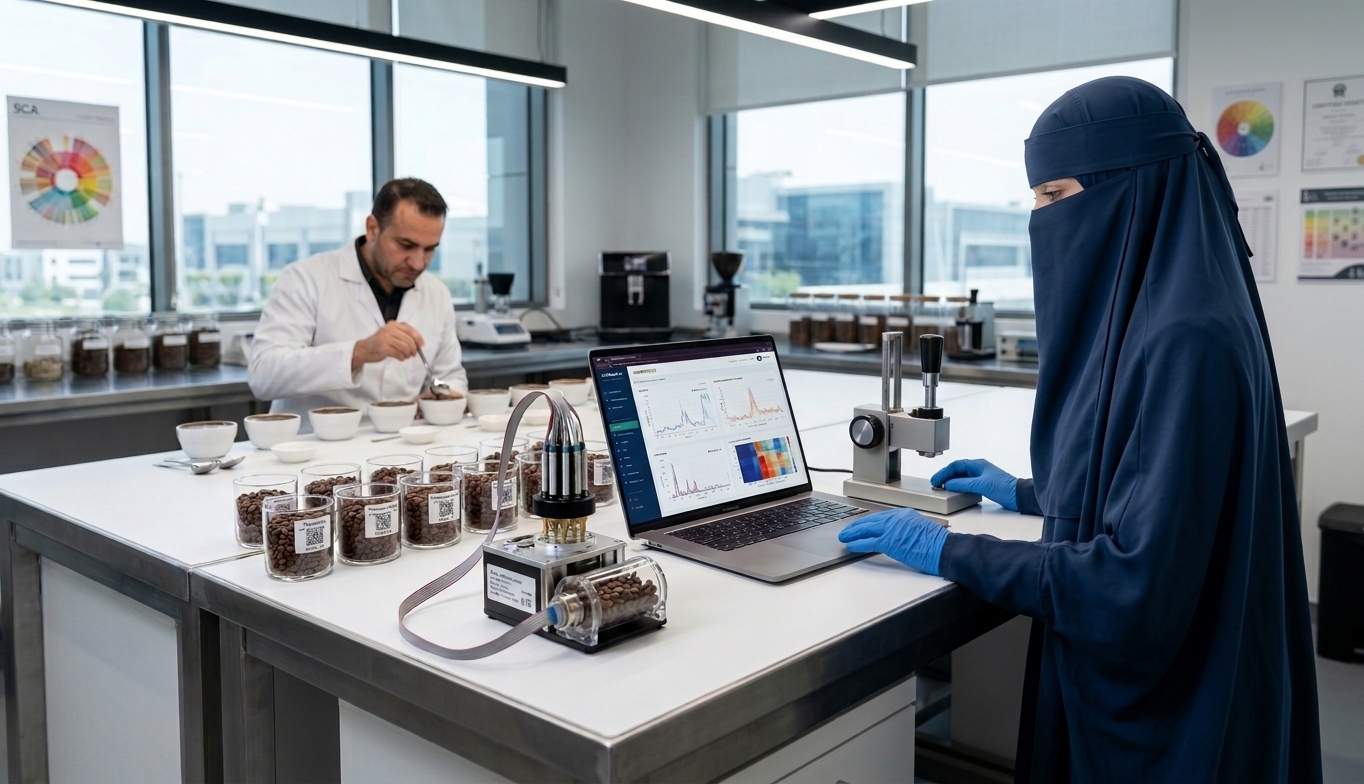
In the world of specialty coffee, the palate and olfactory precision of a certified Q-Grader represent the ultimate gold standard. For decades, green coffee buyers, roasters, and sensory panels have relied on human perception to identify nuanced flavor notes from jasmines and bergamot to subtle quakers and enzymatic defects. However, as global supply chains demand higher consistency and faster quality control, a powerful contender has entered the cupping lab: Digital Olfaction powered by AI.
What is an Electronic Nose (E-Nose)?
An Electronic Nose (E-Nose) is a sensor array designed to detect and recognize complex odors and volatile organic compounds (VOCs). When coffee beans roast, they release hundreds of volatile aroma compounds. While a human sensory panel relies on olfactory receptors in the nasal cavity, an E-Nose uses advanced gas sensors—often paired with Metal-Oxide Semiconductor (MOS) tech—to convert chemical signatures into digital signals.
Machine learning algorithms then analyze these signals against trained datasets, instantly categorizing aroma profiles, roasting consistency, and defect levels within seconds.
E-Nose vs. Q-Grader: Key Operational Differences
• Consistency: Human Q-Graders are subject to fatigue and sensory shift, whereas AI-driven E-Noses offer 100% repeatable, 24/7 continuous operation.
• Analysis Speed: A standard human cupping session takes 15–30 minutes per lot, while digital olfaction delivers results in 30–60 seconds per sample.
• Defect Detection: Humans provide high precision but require years of calibration, while AI offers instant pattern recognition of VOC off-gassing.
• Emotional Nuance: Q-Graders excel at understanding consumer enjoyment, while AI provides pure data without human emotional context.
The UAE Connection: High-Volume Precision in Dubai Ports
In major trading hubs like Dubai where millions of bags of green coffee pass through the DMCC Coffee Centre annually speed and consistency in quality control are critical. Implementing AI-driven digital olfaction allows green bean importers in the UAE to screen massive shipments upon arrival, instantly flagging mold, fermentation errors, or defective batches before they reach local specialty roasteries.
Will AI Replace the Human Touch?
The short answer is no, but it will transform the workflow. An E-Nose cannot experience the joy of a pristine Panama Geisha or judge how a coffee fits into a cafe's brand identity. Instead of replacing Q-Graders, digital sensors will act as their ultimate assistant:
• Automating Raw Screening: Handling routine defect checks and baseline scoring at scale.
• Calibrating Global Teams: Providing objective benchmark data across distributed roasting facilities worldwide.
• Preventing Batch Loss: Real-time aroma monitoring during commercial roasting cycles to catch defects early.
