
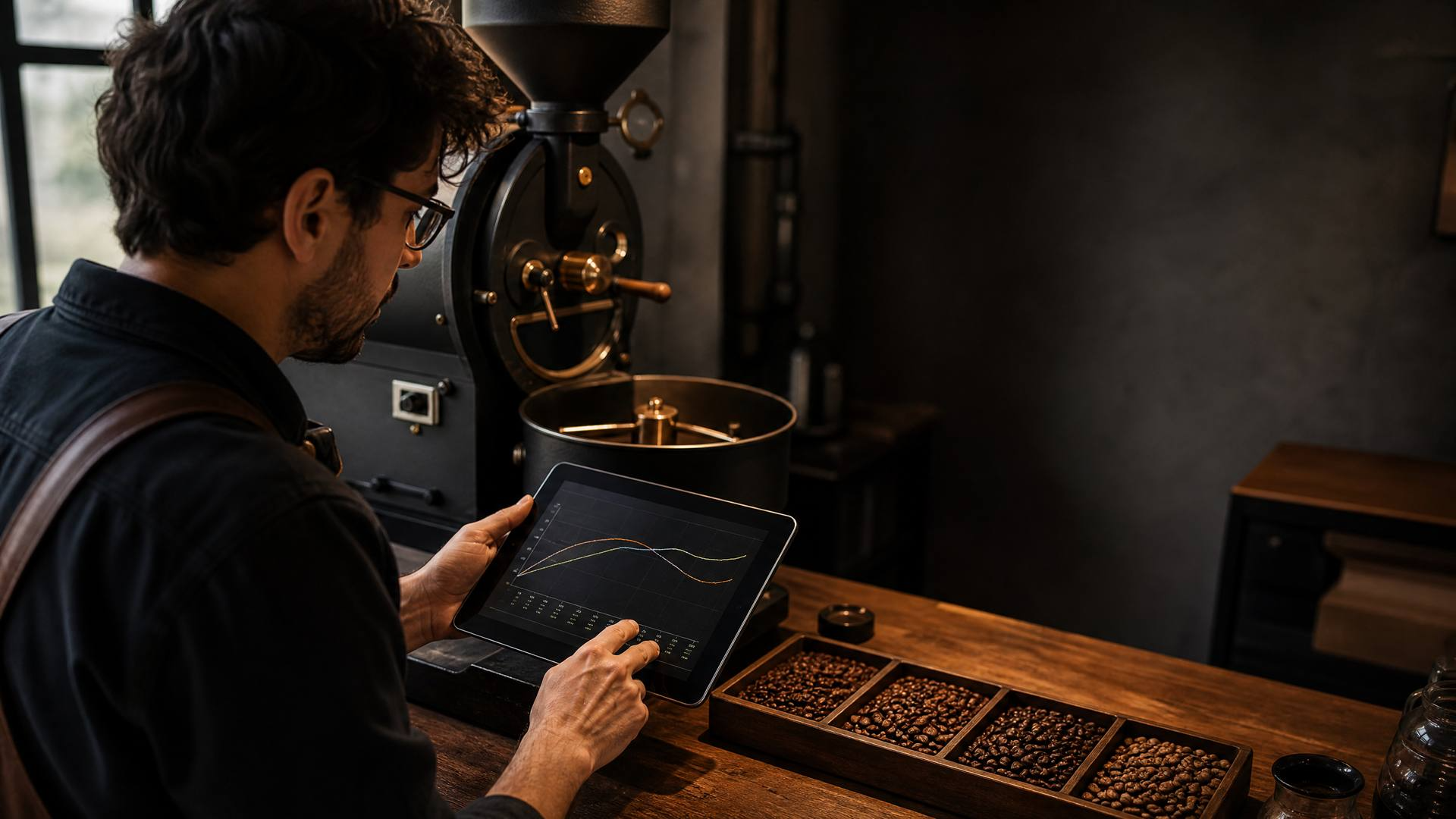
Artificial intelligence is becoming more useful in specialty-coffee roasting, particularly for pattern recognition, prediction, and repeatability. But a roast curve is not a sensory verdict, and the strongest roasteries will use AI to extend not erase human judgement.
A specialty roaster has always worked with data, even when it stayed largely in the roaster’s head: the sound of first crack, the scent of the exhaust, the pace of colour development, a logged curve, and the memory of what the last cupping revealed. Artificial intelligence does not change that foundation. It adds a new layer of measurement and pattern recognition to a process whose thermal and chemical complexity makes repeatability difficult.
For roasteries in the UAE and across the GCC, the practical question is not whether a model can make coffee on its own. It is whether a better data workflow can help the team make more consistent decisions while preserving the sensory standards that make specialty coffee valuable.
What AI can do well in a roast room
Coffee roasting involves heat and mass transfer alongside chemical reactions that affect colour, acidity, sugars, aroma precursors, and flavour. In a 2022 *Journal of Food Engineering* study, researchers used machine-learning models to predict selected chemical-composition changes and lightness in Robusta beans roasted under different conditions. In that controlled experimental setting, the model predictions were reported within ±6.2% for the studied quality indicators.[1]
That result should not be read as a universal promise of cup quality. It does, however, show where AI can be useful: taking many recorded observations and identifying relationships that would be difficult to calculate in real time.
In a modern roastery, a well-designed system can help organise batch histories, flag deviations from a preferred profile, compare results across comparable lots, and make it easier to see whether a proposed adjustment improved consistency. It can also reduce the time spent searching through fragmented spreadsheets, roast logs, and cupping notes. The operational value comes from disciplined records: a model trained on incomplete or inconsistent input will only scale up that inconsistency.
Prediction is not the same as taste
Coffee quality is not a single number. A roast may match a target curve and still disappoint in the cup. Green-coffee age, density, moisture, processing, storage, batch size, ambient conditions, and the brewing context can all matter. A roastery may intentionally favour floral clarity for one coffee, body and sweetness for another, and a deeper development profile for a specific hospitality partner.
Research on sensor-assisted evaluation reflects this difference. A study published in the *Journal of Food Science* combined an electronic nose with artificial neural networks to estimate coffee roasting degree and selected quality parameters. The authors described the approach as a possible route to more reproducible final-bean characterisation and process automation, while recognising that roast-degree assessment had traditionally depended on trained human operators.[2]
That is a useful framing for specialty coffee. Sensors and models can detect repeatable signals. A skilled roaster and a calibrated tasting panel decide whether those signals correspond to a coffee the business wants to serve. AI can support quality control, but it cannot remove the need for cupping, calibration, and accountable human decision-making.
The strongest workflow is human plus model
A practical implementation begins with a narrow problem rather than a grand claim. A roastery might first ask whether historical data can reduce variation in a recurring espresso profile, improve the speed of batch review, or help identify which green-coffee variables deserve closer attention. The team should define success before choosing software: fewer unexpected deviations, faster review of roast logs, or a clearer connection between production data and cupping outcomes.
The human roaster remains responsible for three tasks that models are not positioned to own. First, the roaster decides whether the data is meaningful. A temperature reading or curve anomaly may be the result of a sensor problem, a changed batch size, or a real change in the coffee. Second, the roaster interprets the sensory outcome. The machine can identify correlation; the team must decide whether the cup is balanced, expressive, and appropriate for the intended customer. Third, the roaster makes the commercial trade-off. A curve that is technically repeatable may not be the right choice when coffee cost, blend design, seasonality, or a client brief changes.
This complements the broader service-design question in CoffeeHub’s article on robot baristas in Dubai: technology can improve repeatability and efficiency, but hospitality and judgement remain part of the product.[3]
Four safeguards before buying into the AI narrative
First, ask what data the tool actually uses. A platform that only records roaster temperatures may be valuable, but it is not automatically a sensory model. Second, ask how results are validated. The relevant test is not a generic accuracy percentage in a sales deck; it is whether the tool produces useful, repeatable decisions on your equipment, coffees, and production routine.
Third, keep a human review point after every meaningful recommendation. A model may suggest a change that looks sensible in the dataset but conflicts with a fresh cupping result or a known green-coffee issue. Finally, protect the business’s data. Roasting histories, supplier relationships, production volumes, and customer preferences can be commercially sensitive. Before uploading them to a third-party platform, clarify ownership, access, retention, and export rights.
A better definition of AI-ready roasting
The most AI-ready roasteries are not necessarily the ones with the most complicated software. They are the ones with consistent logging, clear sensory standards, traceable green-coffee information, and a team that can explain why a roast decision was made. These practices make AI more useful—and make the operation better even without it.
For specialty coffee, that is the opportunity. AI can make the roast room more observable, more consistent, and easier to learn from. It should not be presented as a substitute for professional craft. The final quality decision still belongs with people who understand the coffee, taste the result, and accept responsibility for what reaches the customer.
Sources
[1] Ratanasanya, S. et al. (2022). Model-based optimization of coffee roasting process: Model development, prediction, optimization and application to upgrading of Robusta coffee beans*. *Journal of Food Engineering*. https://doi.org/10.1016/j.jfoodeng.2021.110888
[2] Romani, S. et al. (2012). *Evaluation of Coffee Roasting Degree by Using Electronic Nose and Artificial Neural Network for Off-line Quality Control*. *Journal of Food Science*. https://doi.org/10.1111/j.1750-3841.2012.02851.x
[3] CoffeeHub. *Robot Baristas in Dubai Mall: Operational Efficiency vs. The Human Touch*. https://www.coffeehub.ae/news/robot-baristas-in-dubai-mall-operational-efficiency-vs-the-human-touch
